


Context
Faced with growing environmental challenges, sustainable development is no longer the concern of isolated players: while over 80% of French people have taken action to consume more responsibly (Greenflex Study 2019), many companies, whose value proposition has no direct link with the environment, are committed to limiting the negative environmental, social and economic externalities of their business.
It is against this backdrop that Vertone has supported Intermarché Equipement de la Maison as part of its CSR strategy, to reinforce the positive impact of its offer within its three banners (Bricomarché, Bricorama and Bricocash). This project is at the heart of an ambitious CSR transformation strategy, aimed at developing a more responsible, committed and locally-based business.
Objective
Concretely improve the CSR impact of the offer, by acting on four complementary levers:
- Align the offer with the company's ambitions in terms of environmental, social and societal responsibility
- Offer customers the opportunity to take concrete action by directing consumption towards the most responsible product in the range
- Define accessible criteria to sustainably support the efforts of manufacturers in their CSR initiatives, and gradually steer their investments towards more responsible production
- Enhance the value of this responsible strategy to stand out from other players in the sector and strengthen the brand's image
In concrete terms, the project involves defining THE CSR criterion for each product range(eg: France origin, % recycled material, energy class...) to identify the most responsible products to recommend to customers.
An innovative methodology that combines CSR rigor with economic relevance
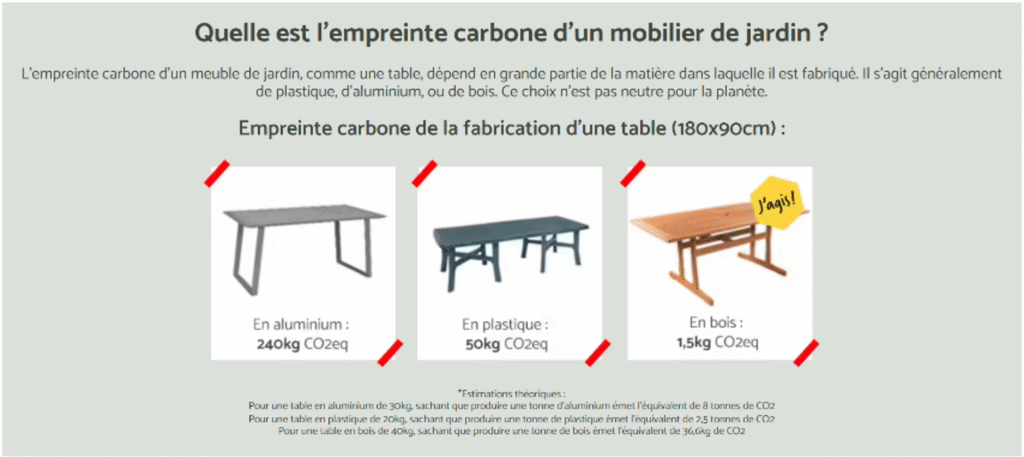
Vertone has built up a rigorous methodology, tested since 2021, to identify THE most relevant criterion for each product range studied. Indeed, reducing the impact of a shower head and a garden table will not require the same levers of action. Products meeting this criterion will be promoted as more responsible throughout the customer's physical and digital purchasing journey.
This methodology is structured around 5 key stages:
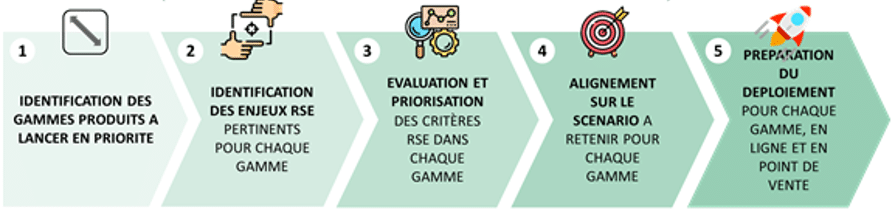
1/ Identification of priority ranges according to their weight in sales, their importance to customers and/or their potential impact on the environment and/or society
2/ Identification of relevant CSR issues for each range
CSR study inspired by LCA methodologies, carried out in partnership with a CSR expert: this stage consists of studying the entire product life cycle in order to identify, for each product range, the phases presenting the most critical environmental, socio-economic or health and safety issues. Calling in the CSR expert can provide tangible evidence, as well as an informed opinion on the particularly complex CSR dimension.
For prioritized issues(e.g. GHG emissions from raw materials extraction), identify one or more relevant criteria options(e.g. % recycled material). A relevant criterion significantly reduces the product's impact on the identified issue, and enables discriminating products to be identified within the assortment sold.
3/ Evaluation and prioritization of CSR criteria to compare criteria scenarios based on actual CSR impact, business feasibility and customer perception
We exposed the most important CSR criteria for each product range to customers, in order to understand the weight of these criteria in their purchasing decisions. Analysis of this cross-referencing of data enabled us to identify the key criteria combining a strong CSR impact with a high customer impact.
4/ Alignment on the scenario to be retained
Restitution of research work and prioritization of CSR criteria to internal teams concerned by each product range (buyers, market managers, etc.)
Decision on the scenario to be retained (CSR issue and criteria) for each range taken in consultation with stakeholders
5/ Preparing for online and POS deployment
Collection of evidence and preparation of communication elements, both:
External - to promote the commitments made and the most responsible products throughout the purchasing process (digital and in-store)
Internal - to train sales teams in the challenges of the ranges and criteria selected
Co-construction, a key factor in project success
To guarantee the success of the project, it is essential to involve all stakeholders in the methodology. The support of each range's internal teams (buyers and/or market managers) is crucial, as they will become the ambassadors of the CSR criteria in the long term.
It also guarantees the intellectual honesty of the approach, so as to arrive at criteria that do not necessarily distinguish between private labels and national brands, or between the most expensive products and the least expensive.
We therefore involved them from the very start of the work on their ranges, during the presentation of the CSR study, and then actively involved them in the final validation of the criteria, to reinforce the appropriation and dissemination of the CSR approach.
Results
- Nearly 40 ranges studied, representing over 50% of the sales of the companies concerned
- Involvement of over 45 employees and 25 suppliers in a collaborative approach to continuous improvement
- Benchmark competitors' commitments and best practices in end-customer communications
- Summary of the results of all customer surveys carried out, enabling us to refine our knowledge of our customers, better understand their expectations of our offer, identify their preferences and understand their sensitivity to CSR issues.
Testimony of Cécile Hébert, CSR Manager at Intermarché Equipement de la Maison :
"Vertone has been working with us for four years on our Responsible Offer program. They defined and structured the methodology needed to define the CSR criteria for our various product ranges, and this methodology has become the real strength of the program. The Vertone teams were able to understand our needs and make optimal proposals to adapt to our time and budget constraints. Even if the teams evolve between each study sprint, the transfer of knowledge and methodology between each sprint is absolutely seamless, and each new team brings improvements and new ideas that make the program both more robust and more agile.
We are proud to be able, today, to direct our points of sale and our customers towards the most responsible products in our offer, and thus make our retail business more virtuous. Thanks to the robustness and transparency of our methodology designed by Vertone, we can encourage our suppliers to commit to the ecological transition, and thus succeed, all together, in changing for a more sustainable trade."
To find out more, contact our team